What Do You Need For Your Business?
Blogs
Businesses today are searching for solutions to provide customers with the best user experience 24/7. They want to achieve this by decreasing service costs and automating everyday tasks by customer service agents. Chatbots and conversational AI bots have emerged as top solutions for these businesses to achieve these goals. These solutions are spoken in the same breath but have major differences. Read this article further to understand these differences and decide which solution your business requires.
In this article you will learn:
What is a chatbot?
What is a conversational AI?
Difference between chatbots and conversational AI
Examples of chatbots and conversational AI
Which solution suits your business the best?
So let’s get started.
What Is A Chatbot?
A chatbot is any computer application that ‘chats’ with the user based on the queries or prompts the user enters into the application. There are two types of chatbots. AI chatbots and script-based chatbots.
Script-based chatbots are the most common types of chatbots. They are used to answer basic queries and FAQs on websites and applications. Script-based chatbots are fed predetermined rules (respond with ‘A’ if the customer asks ‘Y’). It is easier to deploy but has a minimal number of use cases.
AI chatbots on the other hand use
machine learning
and natural language processing to understand queries and give natural and appropriate responses. It can continuously learn from the conversations with the users so that the responses improve and become more human over time.
Conversational AI has found its niche across various industries including healthcare, travel, banking, and e-commerce. Conversational AI is a technology that can respond to text and audio inputs in the most human-like way possible. It can be a voice assistant AI on your smartphone or an AI chatbot on your PC. Using deep learning algorithms, conversational AI is fed large amounts of data to learn the perfect responses so that the user cannot tell the difference between the response from an
or a human.
Conversational AI helps in enhancing the customer experience (CX) through natural human interactions and solving user problems. In any conversations that require a human touch conversational AI swoops in and saves the day.
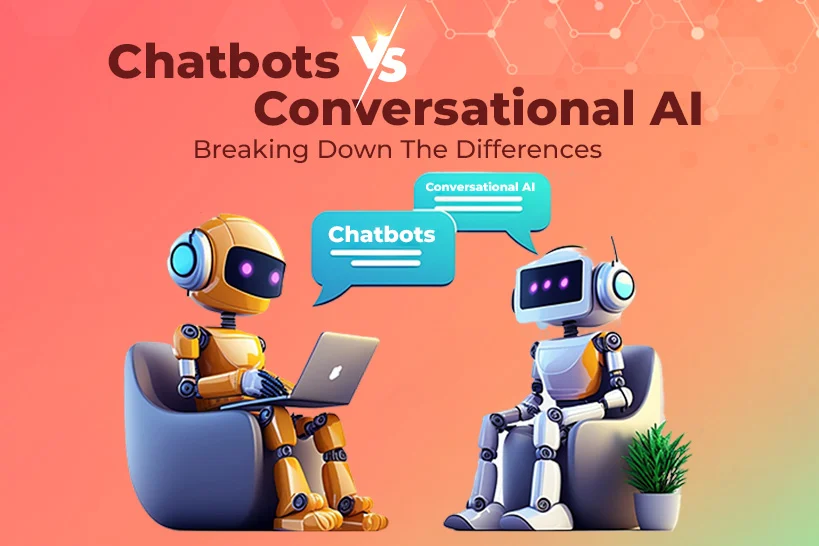
Chatbots vs. Conversational AI: The Basic Differences
Chatbots
Conversational AI
Responds to specific keywords and language identifiers
Understand and interact in the appropriate human languages
Unable to go ‘off script’
Continuously learns interactions with machine learning
Understands only text-based commands
Understands both text and voice-based commands
Have limited use cases such as being utilized as a chat interface
Can be deployed in multiple channels such as websites, social media, applications, and voice assistants
Answers the basic FAQs
Answers more topical and complex questions
Answers to pre-written questions
Generates customized answers based on the user inputs
Chatbots or Conversational AI: What’s Best For Your Business
The differences between both technologies are very subtle. Chatbots are generally used to automate simple tasks and conversational AI’s goal is to engage customers in natural and human-like conversations with the customers and to solve their issues. You can say conversational AIs are a much better option for customer service than chatbots.
Let’s break down why you should choose conversational AI over chatbots.
Modern NLP
There is a pre-determined set of rules for traditional chatbots that only answer frequently asked questions. Conversational AI on the other hand offers a more natural touch to the interactions between chatbots and customers. It is powered by machine learning and natural language processing technologies to continuously learn and improve. It provides truthful responses by learning about past interactions.
Human-like conversations
Imagine talking to a machine and not knowing you are talking to one. This is what customers feel like when they interact with a conversational AI. This reduces the workload of your live agent and brings a more satisfied and loyal customer into your business.
Wide scope
While chatbots have minimal use cases such as answering FAQs, conversational AI on the other hand has a wide scope.
It can be used in call centres, smart speakers at home, or voice assistants in applications. Because of its ability to grow continuously, conversational AIs are preferred over chatbots for live interactions.
Scalability
It’s fantastic to have technology that can scale along with your business. They are an omnichannel presence across multiple platforms such as websites, social media, and applications to improve CX. So as your business grows, your application built on conversational AI also grows.
iBot: World’s Number 1 Chatbot To Improve Your CX
You only need one customer service solution to automate your tasks, enhancing your CX, and increasing your ROI.
iBot
is powered by advanced natural language processing and machine learning to cut down your team's workload by 60%.
iBot by the numbers:
reduction in operational costs
increase in automation rates
boost in CX
conversion vs. traditional methods
to a live demo and transform your business.
FAQs
A chatbot in simple terms is a computer software that replicates human-like conversations to solve customer problems.
What are chatbots used for?
Chatbots are mainly used to automate repetitive tasks that are geared toward customer service such as customer feedback collection, customer onboarding, FAQ responses, and help desk for customers.
Conversational AI is a technology that utilizes machine learning and natural language processing to simulate human-like conversations with customers. Unlike chatbots, conversational AIs continuously learn and improve over time.
What are some of the best chatbot examples in customer service?
Bank of America’s Erica, H&M’s Kik chatbot, and Casper’s insomnobot are some of the best chatbot examples in customer service.