06Feb
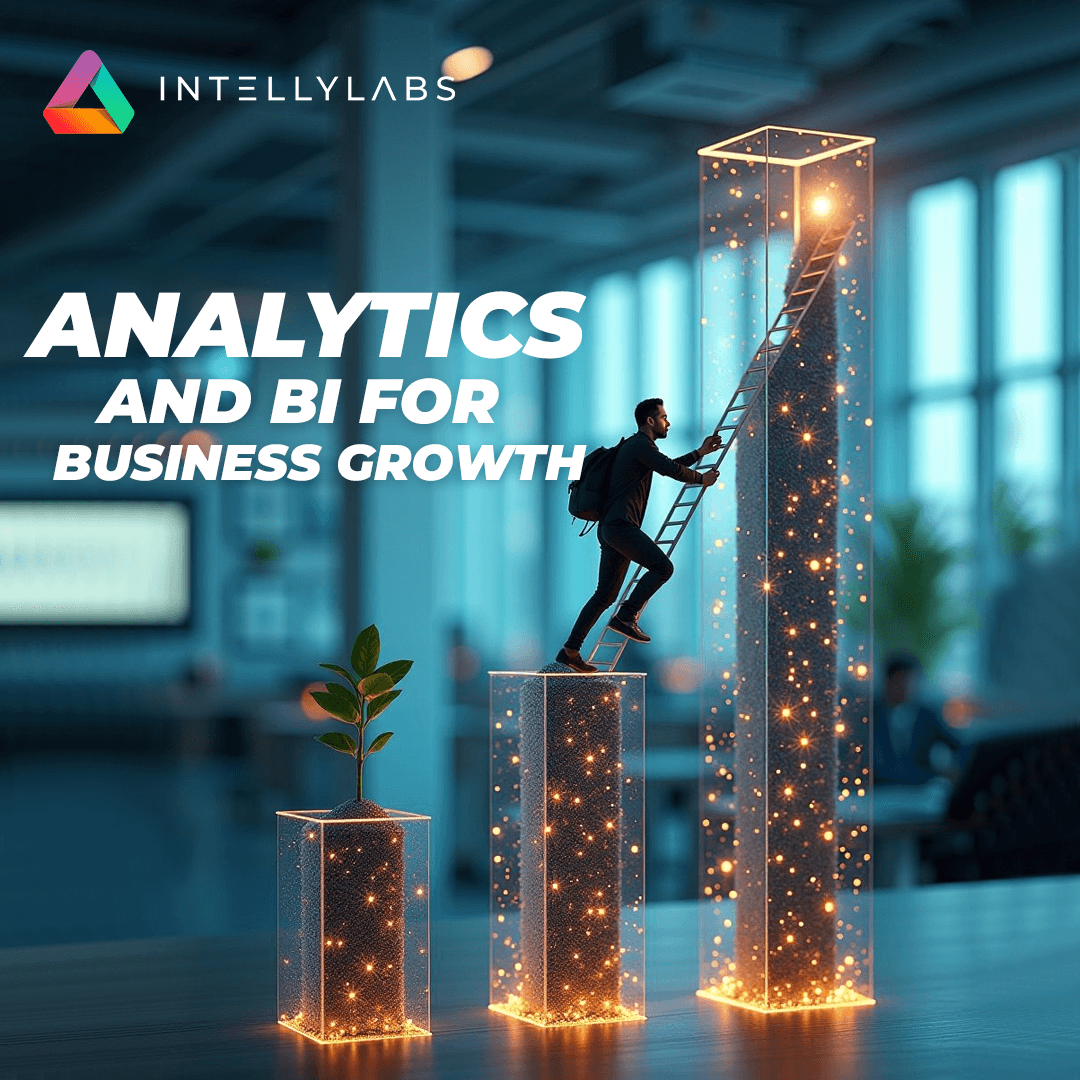
Data-Driven Growth: The Power of Analytics and Business Intelligence.
Introduction: Transforming Data into Actionable Insight
In the modern digital landscape, businesses are constantly generating massive volumes of data—from customer interactions to operational metrics. However, raw data offers little value on its own. Sustainable competitive advantage is achieved by transforming this data into actionable insights through the strategic use of Analytics and Business Intelligence (BI). Organizations committed to data-driven strategies consistently demonstrate superior performance in efficiency, customer satisfaction, and revenue generation. Defining BI and Analytics
- Business Intelligence (BI): Focuses on the tools and processes for collecting, analyzing, and presenting historical and current business data.
- Analytics: Extends BI by applying statistical models, forecasting, and predictive techniques to proactively guide future decision-making.
Together, BI and analytics enable companies to understand past performance, monitor present operations, and predict future outcomes. The Fundamental Role of Analytics in Business Expansion
The adoption of robust analytics practices drives growth across several critical dimensions:
- Superior Decision-Making: Data-driven leadership moves beyond assumptions, using real-time insights to make faster, more accurate strategic choices.
- Deeper Customer Understanding: Analytics allows businesses to segment high-value customers, deeply understand buying behaviors, and personalize marketing campaigns, resulting in higher Customer Lifetime Value (CLV) and retention.
- Enhanced Operational Efficiency: BI tools pinpoint bottlenecks and inefficiencies within supply chains and processes, leading to significant cost reduction, faster cycle times, and optimized resource allocation.
- Accurate Forecasting and Risk Reduction: Predictive analytics enables precise demand forecasting, optimized inventory planning, and effective budget allocation, ultimately boosting profitability and mitigating risk.
Key Business Functions Revolutionized by Data
BI and Analytics are integral to almost every function:
- Sales: Identifies high-potential products and geographic markets.
- Marketing: Measures campaign Return on Investment (ROI) and tracks customer acquisition costs.
- Finance: Monitors profitability, cash flow trends, and financial health.
- Operations: Optimizes production processes and minimizes waste.
- Customer Service: Improves response times and overall customer satisfaction levels.
Overcoming Common Data Challenges
Despite the clear benefits, successful BI implementation faces hurdles:
- Data Quality Issues: Relying on inaccurate or inconsistent data.
- Siloed Systems: Data trapped in separate, non-integrated departments.
- Lack of Actionability: Generating complex reports without clear business objectives or actionable insights.
Successful initiatives prioritize solving specific business problems over merely producing reports.
Best Practices for BI Implementation
To ensure a high return on analytics investment:
- Establish clear, quantifiable business goals from the outset.
- Concentrate efforts on a small number of high-impact metrics.
- Ensure continuous data accuracy and consistency across the organization.
- Provide adequate training for teams to leverage insights effectively.
- Commit to continuous refinement of the analytics strategy.
The Future: AI and Real-Time Analytics
The integration of AI, machine learning, and real-time processing is rapidly advancing the field. Businesses can now:
- Instantly identify growth opportunities.
- Automate decision-making processes.
- Predict complex customer behavior with greater precision.
Organizations that proactively adopt these sophisticated technologies will secure a significant competitive edge.
Conclusion
IntellyLabs help you in reaching to the point where your data is not just data but has a meaning and action plan. Analytics and Business Intelligence are not merely optional tools; they are indispensable foundations for achieving sustainable growth. By strategically harnessing data, organizations can make smarter decisions, dramatically improve operational efficiency, elevate customer experiences, and drive consistent, long-term revenue growth. In this data-driven era, the key determinant of success is not the volume of data you possess, but how effectively you utilize it to fuel your growth trajectory.
Related Blogs
Request for services
Discover range of service offerings for various Engineering Services. Let us know your areas of interest so that we can serve you better.